 Cordia Homeschool
How Do Homeschooled Kids Socialise in Australia? A Real Answer
TL;DR
Homeschooled kids in Australia socialise through sport clubs, co-ops, church and community groups, Scouts and Guides, library programs and mixed-age playgroups, usually across a wider age range than a single school classroom. The real work for parents is building a weekly rhythm of contact, not worrying that home education itself causes isolation.
Homeschooled kids in Australia socialise the same way most families do outside school hours: through sport, church, Scouts and Guides, co-ops, library programs and neighbourhood friendships, usually across a wider mix of ages than a single classroom allows. The worry about socialisation is one of the most common reasons families hesitate before starting, and one of the first things they stop worrying about once they’re a few months in.
Is socialisation really a problem for homeschooled kids?
Not in the way most people fear. The research on this is old and consistent: home-educated children generally show social skills and wellbeing comparable to, and sometimes stronger than, their schooled peers, particularly in comfort talking to adults and younger children. The real issue isn’t a deficit caused by learning at home, it’s that a new homeschooling parent hasn’t yet built the weekly rhythm of contact that school used to provide automatically.
That rhythm doesn’t appear on its own. It has to be built, the same way a school timetable was built for you. Once it exists, most families find their child has more varied social contact than before, not less, because they’re no longer confined to thirty same-age classmates for six hours a day.
Where do Australian homeschoolers actually meet other kids?
Homeschoolers meet other children through community sport, homeschool co-ops and support groups, church and youth groups, Scouts and Guides, library and council programs, and informal park meetups organised through local networks. Every state has an active homeschool community, and most capital cities have several co-ops running weekly or fortnightly.
The main channels families use:
- Homeschool co-ops and support groups – parent-run groups that meet weekly or fortnightly for shared classes, excursions, sport days or simply supervised free play. Nearly every Australian region has at least one, often found through Facebook groups or your state homeschool association.
- Community sport – Little Athletics, swimming clubs, football, netball, gymnastics and PCYC programs all enrol by age, not by school. This is often the single most reliable weekly social anchor for homeschool families.
- Scouts, Guides and cadets – deliberately mixed-age, skills-based and widely available, including in regional areas.
- Church and youth groups – for Christian homeschooling families this is frequently the anchor point of the week, alongside Sunday school and youth ministry peers.
- Libraries and councils – public libraries run school-holiday programs, storytime, coding clubs and school-age activities that any child can attend, homeschooled or not.
- Excursion and incursion days – many co-ops and support groups organise museum, farm, zoo or excursion days specifically because they double as social days.
If you’re still deciding whether to start, the free Start Wizard can map out what a realistic week could look like for your family, including the social side, in about two minutes.
Do homeschooled kids miss out on same-age friendships?
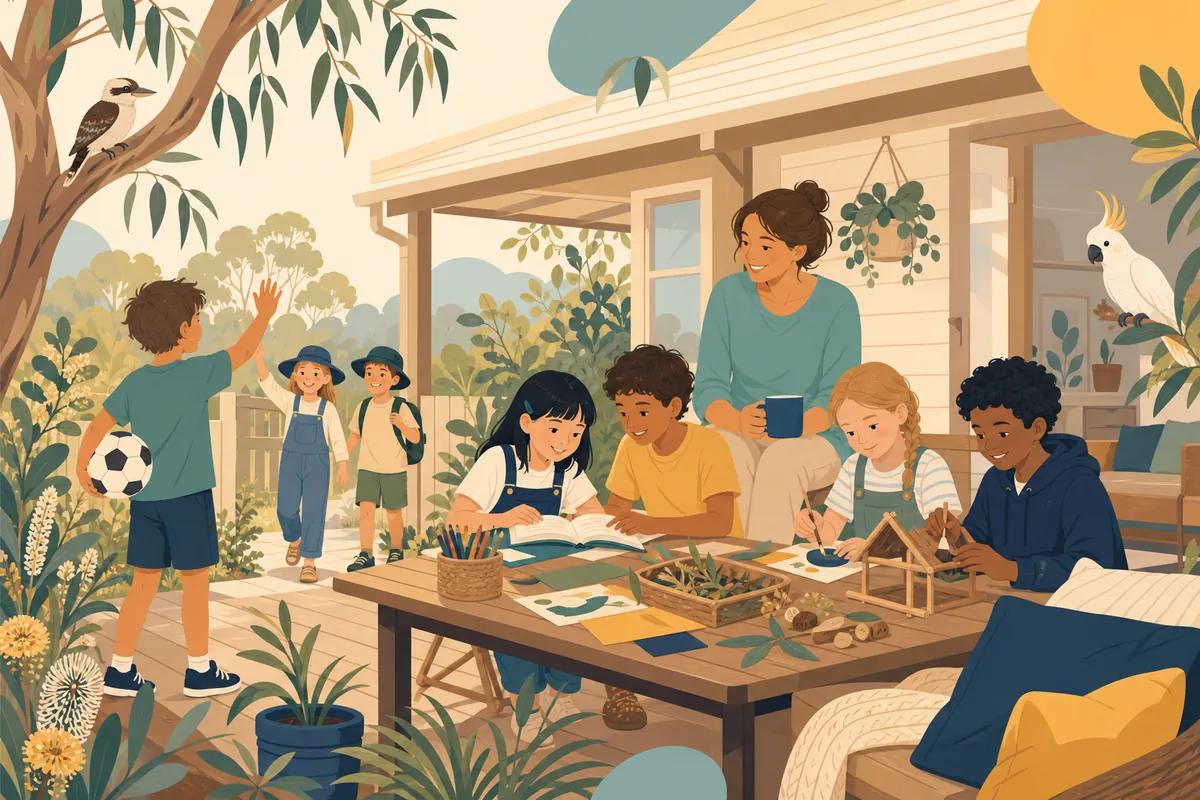
Homeschooled kids typically have fewer same-age classmates but more mixed-age friendships, and most parents find this a genuine benefit rather than a loss. Children learn to talk with toddlers, teenagers and adults, not just a narrow age band, which mirrors how socialising works in family life, workplaces and most of the real world.
That said, same-age friendship still matters, especially for children who crave a close-knit peer group. Co-ops, sport teams and church youth groups are usually where these closer, same-age friendships form, because they meet regularly enough for real bonds to develop rather than one-off playdates. If your child seems to want more same-age contact than they’re currently getting, that’s usually a sign to add one more regular weekly touchpoint, not evidence that home education isn’t working socially.
What about socialising through the teenage years?
Homeschool high school students socialise through part-time work, TAFE or VET courses, sport clubs, church youth groups, volunteering and homeschool teen co-ops, and many gradually build a peer group that looks a lot like any working teenager’s. Teenagers often need less adult-organised socialising and more independence: a part-time job, a driving lesson group, a VET certificate class, or volunteering all put them alongside peers without a parent managing the interaction.
If you’re mapping out the senior years, including how ATAR, VET or other pathways fit alongside social life, the homeschool high school pathways guide on this site is worth reading before you plan Year 10 onward. Registration requirements for senior secondary students also differ by state, so check your state guide if you haven’t already registered.
Is there real research behind this, or is it just reassurance?
There is genuine Australian and international research on home-educated children’s social and emotional outcomes, and it consistently finds no disadvantage linked to the schooling method itself. The Australian Curriculum itself treats social and interpersonal skills as a formal outcome, not an extracurricular add-on: the Personal and Social Capability is one of ACARA’s general capabilities embedded across all learning areas, which registered homeschoolers in most states are already expected to address as part of a compliant learning plan (see ACARA’s general capabilities documentation below).
What matters most, according to the available research and to experienced Australian homeschool families, is opportunity and consistency: a child who has two or three regular social touchpoints a week does well regardless of whether those touchpoints happen at a school desk or a Saturday sport oval.

How do I find a homeschool community in my state?
The fastest way to find a homeschool community is through your state’s homeschool association or Facebook groups, then your local co-op, church and council for ongoing weekly contact. Every Australian state and territory has an established homeschool network, and most regional areas have at least a small, active group even if the nearest capital city co-op is out of reach.
Practical steps to find your people:
- Search Facebook for “[your suburb or region] homeschool” groups, which is where most Australian co-ops and meetups are actually organised.
- Check your state homeschool association’s website for a group directory, since most maintain one.
- Ask at your local library, which often knows which community groups use its meeting rooms.
- Look at council-run school-holiday programs, which draw a broad mix of local families.
- If you’re Christian, ask at your church, since many congregations already have homeschool families quietly connected to each other.
Because registration, reporting and expected hours all vary by state, it’s worth reading the guide for where you live before you lock in a routine: New South Wales, Queensland, Victoria, Western Australia, South Australia, Tasmania, the ACT and the Northern Territory.
What if my child is shy, rural, or has additional needs?
Shy children, rural families and kids with additional needs usually need more deliberate, lower-pressure social settings rather than more of them: smaller co-op groups, one-on-one playdates, structured activities like Scouts or swimming lessons, and enough repetition that the same faces become familiar. Quality and consistency of contact tend to matter far more than quantity for these children.
For rural families, this often means driving further for one reliable weekly activity rather than trying to attend several irregular ones, and leaning on regional homeschool groups who already know the local options. For a child with additional needs, a smaller, calmer setting such as a dedicated homeschool co-op session or a one-on-one activity can offer far more genuine connection than a large, noisy group. If your child has additional needs, it’s worth reading about homeschooling with additional needs in Australia, since the social planning and the learning plan usually need to be worked out together.
How does Cordia fit into the social side of homeschooling?
Cordia’s free Start Wizard helps you build a first-term plan that includes realistic social touchpoints alongside your learning goals, because a good plan accounts for who your child will see each week, not just what they’ll study. It takes about two minutes and gives you a plain-English starting point, whether you’re still deciding or ready to register.
For families who want more structure and ongoing support as they go, including a rhythm that builds in regular group activities and connection with other homeschooling families, it’s worth having a look at Cordia’s plans and pricing to see whether the paid program is the right fit alongside your community involvement. But the social side of homeschooling doesn’t depend on any product: it depends on showing up to the same sport session, the same co-op day and the same church group often enough that real friendships have time to form.
Sources
- Australian Curriculum, Assessment and Reporting Authority (ACARA) — General Capabilities: acara.edu.au
- NSW Education Standards Authority (NESA) — Home Schooling: nesa.nsw.edu.au
- Queensland Government, Home Education Unit: education.qld.gov.au
- Australian Institute of Family Studies (AIFS): aifs.gov.au
Frequently asked questions
Do homeschooled kids get enough socialisation?
Most homeschooled children get plenty of social contact once families build a weekly rhythm around sport, co-ops, church or community groups. The concern usually isn't a lack of contact, it's that it looks different from a classroom, spread across mixed ages and outside school hours rather than concentrated in one room of same-age peers.
Will homeschooling make my child socially awkward?
There is no evidence that home education itself causes social difficulty. Temperament, opportunity and how much mixed-age, real-world interaction a child gets matter far more than the schooling method. A shy child can struggle in either setting, and a well-connected homeschooled child often has more practice talking with adults and younger children than a same-age school peer.
How many hours a week should homeschoolers spend with other kids?
There's no official rule, but most established homeschool families aim for two to four regular touchpoints a week, such as a sport training session, a co-op day, a church or youth group, and one informal playdate or park meetup. Consistency matters more than the total hour count.
Can homeschooled kids join school sport or extracurricular programs?
Homeschooled children can join almost all community sport, arts and youth programs, since clubs like Little Athletics, PCYC, swimming squads, Scouts and Guides enrol by age, not by schooling type. Some individual schools allow homeschoolers into specific programs at their discretion, but this varies and isn't guaranteed, so community-based options are the more reliable path.
What if we live rurally or my child is an only child?
Rural and only-child families often lean more heavily on distance-friendly options: online co-ops, regional homeschool group meetups, agricultural shows, local sport even if it means driving, and church or community events that draw families from a wide area. It takes more deliberate planning, but it is very workable, and other rural homeschoolers in your state group are usually the fastest source of local leads.
Get a home-education plan built around your child
Cordia turns everything above into a personalised, curriculum-aligned plan — with a free Start Wizard that pre-fills your state's steps in two minutes.