 Cordia Homeschool
Homeschooling in Victoria: The Complete 2026 Guide to Registering and Staying Compliant
TL;DR
Home education is legal in Victoria once you register your child with the VRQA. Victoria is the most flexible state on curriculum — you don't have to follow the Victorian Curriculum or any set curriculum — provided your program, as a whole, substantially addresses the eight learning areas. Registration runs on the calendar year, and you confirm your intention to continue by 30 November each year. Only about 10% of families are reviewed annually, and home visits are not compulsory.
Victoria at a glance
The long guide below explains the detail. This preserves the existing quick guide as a practical checklist, with the source beside each consequential claim.
Official authority
Victorian Registration and Qualifications Authority (VRQA)
Open the official VIC page ↗Program standard
You decide what content to include in your home education program — you don't have to follow the Victorian Curriculum or any other specific curriculum. Your learning plan must address 8 key learning areas: English, Mathematics, Science, Humanities and Social Sciences, the Arts, Languages, Health and Physical Education, and Technologies.
Official source ↗verified 2026-07-16
Application checklist
- A completed application form (all sections).Source ↗ · verified 2026-07-16
- Evidence of your child's name and date of birth — a birth certificate, passport, citizenship documents, or Australian visa documents.Source ↗ · verified 2026-07-16
- Evidence you hold parental responsibility — e.g. the child's birth certificate, a Medicare card showing the family, or a relevant court order.Source ↗ · verified 2026-07-16
- A learning plan for each child.Source ↗ · verified 2026-07-16
Timing to diarise
Approval can take up to 28 days after a complete application is received. Registration covers ages 6–17 and runs year to year — towards the end of each year the VRQA emails to ask if you intend to continue for the following year.
Source ↗verified 2026-07-16
After registration
Respond to the VRQA's annual email confirming you intend to continue home schooling. You must also tell them within a reasonable time about any change to your child's name, the responsible parent's details, or the home schooling address — and notify them within 14 days if you stop home schooling.
Source ↗verified 2026-07-16
Victorian home-schooling registrations reached 11,691 as at 30 June 2025 across 8,154 households, up from 6,405 in 2020.
Source ↗ · page updated 2026-06-16
Home education is legal in Victoria and, on curriculum, it is the most flexible jurisdiction in Australia — you are free to choose any approach, or none, as long as your program covers the eight learning areas overall. You register with the VRQA, submit a learning plan, and confirm each year that you intend to continue. This guide walks through every step in plain English, with links to the official sources.
The quick checklist above preserves the action-first version; the detailed guidance begins below.
Is homeschooling legal in Victoria?
Yes — home education is completely legal in Victoria for children of compulsory school age, provided you register with the Victorian Registration and Qualifications Authority (VRQA). The governing law is the Education and Training Reform Act 2006 (Vic), which requires every child of compulsory school age (6–17) to be enrolled at a school or registered for home schooling.
You do not need a teaching qualification, and Victoria is refreshingly light-touch on how you teach. What it asks is that you register before you begin, submit a learning plan, and cover the eight learning areas across your program as a whole. Applications are normally assessed within two weeks, and can take up to 28 days.
Who can register, and at what age?
Registration covers children of compulsory school age. Children must be registered by their 6th birthday, and the registrable age range is 6 to 17. That is the window in which a Victorian child must be either enrolled at a school or registered for home schooling.
A couple of practical points:
- If your child currently attends a school, keep them enrolled until your VRQA registration is confirmed, so there’s no gap.
- Registration is per child, so you lodge an application for each child.
Not sure which learning areas to prioritise for your child’s stage? The free Cordia Start Wizard helps you shape a plan in a couple of minutes.
How registration works: the four-step application
Victoria uses a straightforward four-step process: the application form, the required documentation, the learning plan, and submission. You apply, the VRQA assesses (normally within two weeks, up to 28 days), and once approved you can home educate.
The practical sequence is:
- Complete the application form — your details, your Victorian residential address, proof of parental responsibility, and your child’s details.
- Attach the required documentation and signed declarations from all applicants.
- Include your learning plan appropriate to your child’s needs (covering location, planned start date, and any exemption or partial-enrolment requests).
- Submit, and wait for assessment.
Registration then runs on the calendar year — which brings us to the one date every Victorian home educator must remember.
What you need to apply
Your application has two parts: the form (with identity and parental-responsibility details) and a learning plan that shows how you’ll educate your child. The form captures applicant details, your Victorian residential address, proof of parental responsibility, and your child’s details, with signed declarations from all applicants.
The learning plan is the heart of it — but Victoria keeps this deliberately flexible. It should be appropriate to your child’s educational needs and cover practical details like where learning happens, your planned start date, and any exemption or partial-enrolment requests. Crucially, it does not have to follow any prescribed template or curriculum; it just needs to show a considered plan that will substantially address the eight learning areas over time.
Do you have to follow the Victorian Curriculum?
No — and this is what makes Victoria the most flexible state in the country. The VRQA’s registration page says it directly: “You decide what content to include in your home education program. You don’t have to follow the Victorian Curriculum or any other specific curriculum.”
The only binding requirements are that your instruction, taken as a whole, substantially addresses the eight learning areas — English, Mathematics, Science, Humanities and Social Sciences, the Arts, Languages, Health and Physical Education, and Technologies — and is consistent with the principles and practice of Australian democracy. There is no prescribed syllabus, no requirement to use the Australian Curriculum, and no set materials.
That freedom is a gift, but it also means the responsibility for a balanced, well-rounded program sits with you. A structured plan that maps naturally across all eight learning areas makes it easy to show breadth while still teaching in your own style — a Christian program, unit studies, project-based learning, or a blend. That is exactly what Cordia is built to generate: a personalised plan that covers the areas Victoria expects without boxing your child in. See how it fits on our pricing page.

The annual review — and who gets selected
Victoria does not require every family to submit an annual report. Instead, up to 10% of registered families are selected for review each year, usually notified around February or March. If you’re selected, the review can be a desktop check (you email evidence), a phone or video call, or a face-to-face meeting — home visits are not compulsory — and only one child per family is reviewed, even if you home educate several.
The VRQA does not mandate a specific format or minimum volume of evidence: “VRQA do not mandate what the evidence should be or how you must provide it.” You choose a representative period — a detailed week, or a year-end summary — to demonstrate the education provided. Acceptable evidence includes parent reports, journals, samples of work, extracts from learning apps, and photographs.
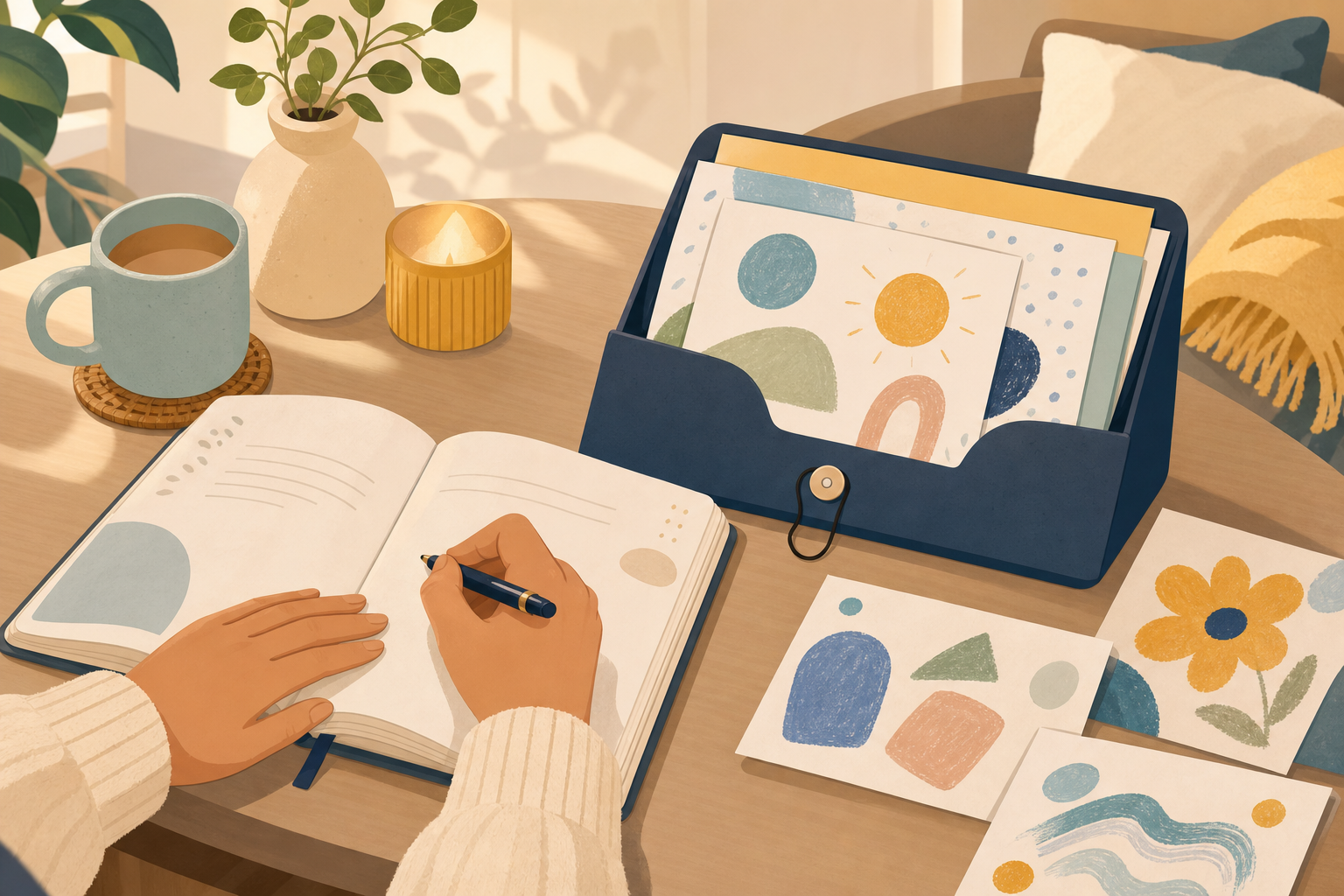
Because selection is random and light-touch, the smart habit is simply to keep a little evidence as you go, so that if you are chosen, assembling it is easy rather than stressful.
Staying registered: the 30 November date
Your one recurring obligation in Victoria is the annual continuation notice. Registration runs on the calendar year, and to continue for the following year you must actively notify the VRQA in writing by 30 November. The VRQA also emails families toward year’s end to ask whether they intend to continue — but the onus is on you to confirm, so diarise 30 November every year.
Miss it, and your registration can lapse; keep it, and there’s no full re-application to complete. It is the single most important date in the Victorian home-education calendar.
Can my child attend school part-time?
Yes — Victoria is one of the states that accommodates flexible arrangements, and your learning plan can include a request for partial enrolment (your child attending a school part-time while being home educated for the rest). This is genuinely useful for families easing into home education, or for keeping a child connected to particular subjects, electives or social groups at a school.
Because partial enrolment involves both the VRQA and the school, flag it in your application from the start rather than bolting it on later — your learning plan is where you note any exemption or partial-enrolment requests. If you think you might want a mix now or down the track, it’s worth raising early so the arrangement is documented and everyone is on the same page. As always, the school itself has a say in whether and how a part-time place works, so have that conversation alongside your VRQA application.
A simple step-by-step to get registered
- Confirm your child’s age — register by their 6th birthday; the range is 6 to 17.
- Gather your details — identity, Victorian residential address, proof of parental responsibility.
- Write a learning plan appropriate to your child, designed to substantially address the eight learning areas.
- Submit to the VRQA — assessment is normally within two weeks (up to 28 days).
- Keep your child enrolled at school until registration is confirmed.
- Keep a little evidence as you go, in case you’re one of the ~10% reviewed.
- Notify the VRQA by 30 November each year to continue.
Victoria rewards parents who plan for breadth and diarise one date. The flexibility is real — use it well.
Ready to build a plan that covers all eight learning areas for your child? Start with the free Cordia Wizard, compare the stricter states with our New South Wales guide, or browse more guides on the blog. Wherever you are, you can find your state’s official steps here.
Sources
This guide draws on VRQA primary sources, accessed July 2026. Always confirm the current detail on the official pages before you lodge:
- VRQA — Register to home educate (application process, curriculum flexibility, the eight learning areas).
- VRQA — Home education (overview, annual continuation by 30 November).
- VRQA — Understand home education reviews (the ~10% review, formats, evidence).
- VRQA — Develop a home education learning plan (what the learning plan should contain).
- Victorian legislation — Education and Training Reform Act 2006 (the governing framework).
Frequently asked questions
Is homeschooling legal in Victoria?
Yes. Home education is legal in Victoria for children of compulsory school age, provided you register with the Victorian Registration and Qualifications Authority (VRQA). You must register before you begin, and applications are normally assessed within two weeks (and can take up to 28 days).
Do I have to follow the Victorian Curriculum?
No — Victoria is the most flexible state. The VRQA states plainly: you decide what content to include, and you don't have to follow the Victorian Curriculum or any specific curriculum. The only binding requirement is that your program, taken as a whole, substantially addresses the eight learning areas and is consistent with the principles and practice of Australian democracy.
What are the eight learning areas I have to cover?
English, Mathematics, Science, Humanities and Social Sciences, the Arts, Languages, Health and Physical Education, and Technologies. Your program as a whole must substantially address these — but you choose how, with no prescribed syllabus or set materials.
Will the VRQA review my home schooling?
Possibly. Up to 10% of registered families are selected for review each year, usually notified around February or March. Reviews can be a desktop check of emailed evidence, a phone or video call, or a face-to-face meeting — home visits are not compulsory, and only one child per family is reviewed even if you home educate several.
Do I have to re-register every year in Victoria?
Registration runs on the calendar year (January–December). You don't complete a full new application each year, but you must actively notify the VRQA in writing by 30 November that you intend to continue for the following year. The VRQA also emails toward year's end to ask.
At what age must I register my child in Victoria?
Children must be registered for home schooling by their 6th birthday, and the registrable age range is 6 to 17. If your child currently attends school, keep them enrolled until your registration is confirmed.
Get a home-education plan built around your child
Cordia turns everything above into a personalised, curriculum-aligned plan — with a free Start Wizard that pre-fills your state's steps in two minutes.