 Cordia Homeschool
A Realistic Weekly Homeschool Schedule for Australian Families

TL;DR
A realistic homeschool week usually combines short focused lessons, independent work, practical learning, outings and rest rather than copying school hours at home. Your schedule should support your registered learning plan, suit each child’s age and remain flexible enough for appointments, difficult days and family life.
A realistic homeschool weekly schedule in Australia usually includes four or five days of short, focused lessons, with time for independent work, practical learning, outings and rest. It does not need to copy school hours, but it should support your child’s registered learning plan and your state or territory’s home education requirements.
The best schedule is not the fullest one. It is the one your family can follow consistently, adjust when life happens and use to show that each child is receiving a suitable education.
What should a realistic homeschool week include?
A workable week should cover your planned learning areas, regular literacy and numeracy, opportunities to apply knowledge, movement, social connection and time to review progress. You do not need to teach every subject every day. Spread learning across the week so that demanding work and lighter activities are sensibly balanced.
For many families, that means:
- literacy and numeracy on most learning days
- two or three longer sessions for science, humanities or projects
- regular physical activity
- creative, practical or technology-based learning
- independent reading
- an excursion, library visit, co-op or community activity
- a short weekly review and record update
The Australian Curriculum can help you understand typical learning content and achievement expectations. However, home education is regulated by states and territories, and the way you describe or organise your program may differ depending on where you live.
Start with your approved or proposed learning plan rather than building a timetable from random online printables. If you do not yet have one, this learning plan guide and example explains how to turn broad goals into teachable activities.
A simple planning rule is:
Plan the essentials first, add supporting activities second, and leave some space unfilled.
That spare space is not wasted. It gives you room for difficult maths lessons, spontaneous interests, appointments, illness and ordinary family life.
How many hours should homeschooling take each day?
Most home education days do not require six hours of direct teaching because individual instruction is more concentrated than classroom teaching. Younger children may complete focused lessons in one to two hours, while older students often need longer. Reading, experiments, projects, excursions and practical work also count as genuine learning.
A useful starting range is:
| Stage | Focused lesson time | Typical lesson length |
|---|---|---|
| Prep to Year 2 | 1–2 hours | 10–20 minutes |
| Years 3–6 | 2–3 hours | 20–40 minutes |
| Years 7–9 | 3–4 hours | 35–60 minutes |
| Years 10–12 | 4–6 hours | 45–90 minutes |
These are planning guides, not legal minimums. A Year 1 child may spend 15 minutes on explicit phonics, then practise language through stories, conversation, handwriting and play. A Year 10 student may complete several hours of structured coursework but still need time for exercise, work experience, VET activities or independent projects.
Watch the child, not only the clock. A short lesson completed with attention is more useful than an hour spent exhausted or distressed. Stop, change approach or return later when concentration has clearly gone.
What is an example homeschool weekly schedule?
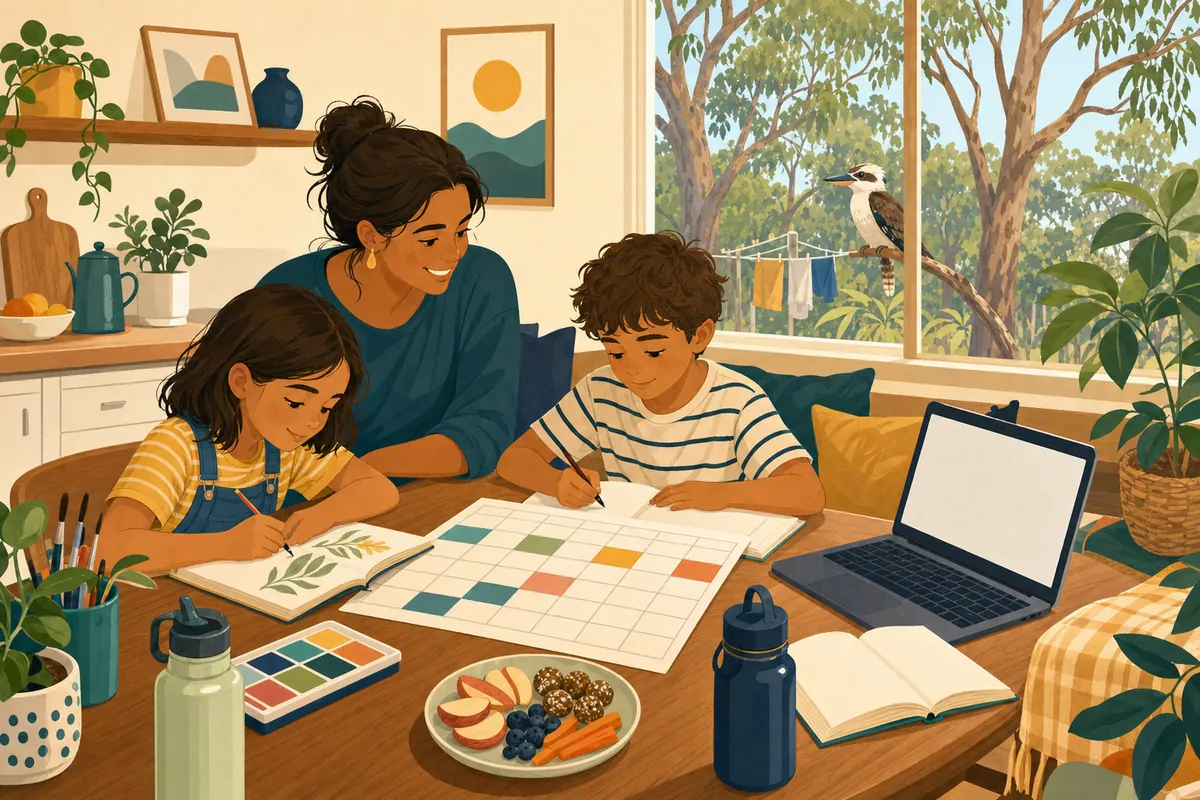
A balanced weekly schedule can use Monday to Thursday for core lessons and reserve Friday for projects, outings, catch-up work and planning. This creates consistency without making every day identical. Families who prefer shorter days can distribute the same work across five mornings instead.
Here is a practical example for a family with primary-aged children:
| Time | Monday | Tuesday | Wednesday | Thursday | Friday |
|---|---|---|---|---|---|
| 8:30 | Morning routine and read-aloud | Morning routine and read-aloud | Morning routine and read-aloud | Morning routine and read-aloud | Weekly check-in |
| 9:00 | English | English | English | English | Catch-up or library |
| 9:45 | Break | Break | Break | Break | Outing or project |
| 10:00 | Maths | Maths | Maths | Maths | Outing or project |
| 10:45 | Snack and movement | Snack and movement | Snack and movement | Snack and movement | Outing or project |
| 11:15 | Science | Humanities | Science | Humanities | Practical learning |
| 12:00 | Lunch | Lunch | Lunch | Lunch | Lunch |
| Afternoon | Reading, music or sport | Art or errands | Co-op or park group | Cooking or technology | Work samples and planning |
For Prep to Year 2, shorten each formal block and add more play, movement and hands-on work. For Years 7 to 12, extend subject blocks and use a weekly task list so students can gradually manage their own deadlines.
You might also use theme days:
- Monday: strong start with English, maths and science
- Tuesday: English, maths, humanities and sport
- Wednesday: core work plus co-op, library or excursion
- Thursday: English, maths, science and creative work
- Friday: projects, catch-up, life skills and record-keeping
The exact arrangement matters less than whether it is clear, repeatable and connected to your educational goals.
How do I schedule more than one child?
Teach shared material together where it makes sense, then separate children for skill-based lessons such as reading instruction and maths. A rotation system helps one child receive direct teaching while siblings complete independent, practical or quiet tasks that they already know how to do.
A simple three-child rotation could look like this:
- Family start: read-aloud, prayer or reflection if that suits your family, calendar, discussion and memory work.
- Rotation one: teach the youngest child reading while the others complete independent maths or reading.
- Rotation two: teach the middle child maths while the youngest plays nearby and the oldest continues assigned work.
- Rotation three: check the oldest child’s work and explain new material while younger children complete drawing, handwriting or an educational activity.
- Shared subject: complete science, history, geography, art or nature study together, adjusting the expected output by age.
Shared learning does not mean requiring identical work. After a family science experiment, a six-year-old might draw and label what happened, a ten-year-old might write a paragraph, and a teenager might analyse the result using subject-specific vocabulary.
Avoid scheduling every child to need you at the same time. Mark tasks as:
- Together: you teach or discuss as a family
- With me: the child needs direct instruction
- Independent: the child can proceed alone
- Later: optional work if time and energy allow
This gives children a clear next step and reduces the repeated question, “What do I do now?”
How can I make the schedule fit each age?
The younger the child, the shorter and more physical the learning blocks should be; older students need longer periods, clearer deadlines and increasing independence. Keep the weekly structure predictable, but adjust the amount of written work, direct teaching and personal responsibility to the child’s development and needs.
Prep to Year 2
Prioritise reading instruction, oral language, handwriting foundations and practical maths. Use stories, songs, manipulatives, drawing, nature walks and play. One strong morning is usually more productive than stretching formal lessons throughout the day.
Years 3 to 6
Continue explicit English and maths while building independent reading and written expression. Children can manage short checklists, simple research and projects, but they still need regular instruction and feedback.
Years 7 to 9
Use subject blocks and a weekly task sheet. Teach students how to break assignments into steps, use reliable sources and check their own work. Keep daily contact rather than assuming independence will develop automatically.
Years 10 to 12
Plan backwards from each student’s intended pathway. Senior students may be working towards tertiary entry, vocational education, employment, an alternative admissions pathway or a combination of these. Their week may include coursework, assessment preparation, work experience and external classes.
A schedule is also allowed to change for a child with disability, illness, anxiety or other additional needs. Reasonable pacing, sensory breaks, assistive technology and alternative ways to demonstrate learning can be part of a thoughtful educational program.
Do homeschoolers need to follow school hours?
Australian home educators generally organise learning differently from schools, but they must meet the requirements of their own state or territory. Regulators focus on the child’s education, proposed program and evidence in different ways, so do not treat another family’s timetable as proof that your own arrangements are compliant.
Official requirements and processes can change. Use your regulator’s current information and the relevant Cordia guide:
- New South Wales registration guide
- Queensland home education guide
- Victoria home education guide
- Western Australia home education guide
- South Australia home education guide
- Tasmania home education guide
- ACT home education guide
- Northern Territory home education guide
For example, Queensland’s Home Education Unit administers home education registration, while the Victorian Registration and Qualifications Authority provides Victoria’s home schooling registration information. NSW families should refer to NESA’s home schooling information.
If registration is still ahead of you, begin with Cordia’s plain-English home education starting point. Your state regulator remains the authority on your legal obligations.

How do I leave room for social activities?
Plan social connection deliberately, but do not fill every afternoon. One or two regular activities plus ordinary community life can provide consistent friendships without exhausting the family or crowding out learning, rest and unstructured play. Choose activities your child can attend often enough for relationships to develop.
Social opportunities may include:
- homeschool groups or co-ops
- church, youth group or children’s ministry
- team or individual sport
- Scouts, Guides, dance, drama or music
- library programs
- volunteering and community events
- time with neighbours, cousins and family friends
- part-time work for older teenagers
Put recurring commitments into the weekly schedule first. Then arrange demanding academic work around them. If Tuesday afternoon sport leaves everyone tired, make Tuesday morning focused and keep Wednesday’s start gentler.
Socialisation does not require constant group activity. Children also need time to play, pursue interests and recover from busy settings. Our guide to how homeschooled children socialise in Australia discusses this in more detail.
What records should I keep each week?
Keep enough evidence to show what your child has been learning, how the program is being implemented and how progress is developing. The required form and level of detail vary by jurisdiction, but a brief weekly log plus dated work samples is far more manageable than reconstructing months of learning later.
A useful weekly record can include:
- dates or days of learning
- subjects or learning areas covered
- books, resources and programs used
- short notes about activities or excursions
- one or two observations about progress
- difficulties that need follow-up
- photographs of practical work
- selected drafts, completed work and assessments
- changes made to the next week’s plan
You do not need to keep every worksheet. Choose samples that show range and progress, including early attempts, feedback and later improvement. Store digital records by child, year and learning area so they are easy to retrieve.
Friday afternoon is a useful time to spend 15 minutes updating the log, photographing larger work and selecting samples. This small habit makes reporting, reviews and future planning much less stressful.
Check your regulator’s guidance rather than assuming one record system applies nationally. Official starting points include the South Australian Department for Education, Western Australian Department of Education and Tasmania’s Office of the Education Registrar.
How do I make a schedule we will actually follow?
Build the schedule around your family’s real energy, commitments and limitations rather than an idealised school day. Start with a light version for two weeks, observe what works, and then adjust. A routine should reduce decisions and anxiety, not become another standard against which everyone feels they are failing.
Use these steps:
- List fixed commitments. Include work hours, appointments, sport, co-ops and regular family responsibilities.
- Choose your strongest learning window. Put English, maths or other high-priority work when your children concentrate best.
- Set weekly targets. Decide what should be completed by Friday without assigning every minute.
- Create a minimum day. Choose the essentials you can manage during illness, poor sleep or disruption, such as reading, maths review and a read-aloud.
- Keep one buffer block. Reserve time for unfinished work or an activity that took longer than expected.
- Review after two weeks. Remove unnecessary tasks before adding new ones.
It is also wise to budget before buying multiple subscriptions and boxed programs. This realistic guide to Australian homeschooling costs can help you separate essential expenses from optional extras.
If you want help turning your family details into a starting plan, the free two-minute Start Wizard gives you a practical next step. Families who prefer a more structured program can also review Cordia’s school plans and pricing, but a paid program is not necessary to begin building a workable week.
Your first schedule does not need to be perfect. It needs to be clear enough to try, flexible enough to revise and grounded in the learning plan and registration requirements that apply to your child.
Sources
- Australian Curriculum, Assessment and Reporting Authority: Australian Curriculum
- Queensland Department of Education: Home education
- NSW Government and NESA: Home schooling
- Victorian Registration and Qualifications Authority: Home schooling registration
- South Australian Department for Education: Home education
- Western Australian Department of Education: Home schooling
- Tasmanian Office of the Education Registrar: Home education
Frequently asked questions
How many hours a day should I homeschool in Australia?
There is no single daily number that suits every child or every state requirement. Many families use two to four hours of focused learning for school-aged children, with reading, projects, outings and practical activities adding to the broader educational program.
Do Australian homeschoolers have to follow school hours?
Home education is not normally expected to reproduce a classroom timetable, but registration and education requirements vary between states and territories. Check your regulator’s current guidance and make sure your weekly routine supports the learning program approved or registered for your child.
Should we homeschool four days or five days each week?
Either can work. A four-day academic schedule can leave one day for excursions, appointments, projects and catch-up work, while a five-day schedule may suit children who benefit from shorter lessons and a highly predictable routine.
How should I schedule homeschooling for multiple children?
Begin together with shared reading, discussion or family subjects, then rotate between individual teaching and independent tasks. Keep younger children’s lessons short and give older students a visible checklist so they can continue while you help a sibling.
What records should I keep of our homeschool week?
Keep records that show what was taught, examples of your child’s work and evidence of progress over time. The exact expectations differ by state or territory, so follow your regulator’s guidance rather than relying on a generic national checklist.
Get a home-education plan built around your child
Cordia turns everything above into a personalised, curriculum-aligned plan — with a free Start Wizard that pre-fills your state's steps in two minutes.